AE4

AE4™ Courses

Learn. Design. Build. Innovate.

AE4 courses move students beyond simply learning about technology. Students use technology, engineering, science, design, and entrepreneurship to investigate authentic problems and develop solutions.

Through problem-based learning and the AE4 Innovation Learning Cycle, students develop technical skills while learning to empathize with users, define problems, generate ideas, manage projects, prototype solutions, test assumptions, analyze results, and communicate their work.

Courses can serve as stand-alone learning experiences or become part of a personalized, multi-year AE4 Innovation Scholar pathway.

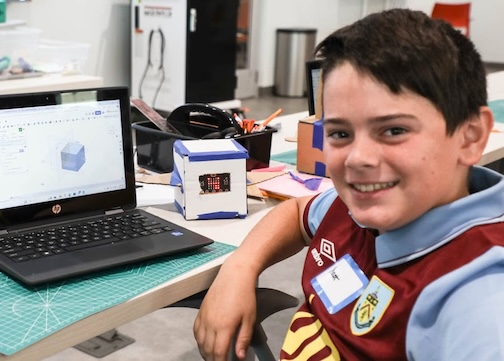
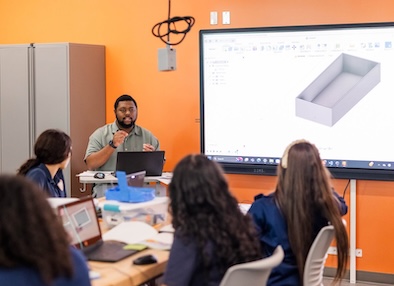
AE4 student designing a 3D model in a classroom studio
Course 01

Fundamentals of Innovation, Mechatronics & Entrepreneurship

From Problem to Prototype to Possibility

Fundamentals of Innovation, Mechatronics & Entrepreneurship is the foundational AE4 course and the entry point into the AE4 innovation experience.

Students are introduced to the tools, technologies, and processes innovators use to transform problems into potential solutions. Rather than beginning with a predetermined project, students learn to investigate authentic problems, understand the people affected by them, and develop solutions through an iterative design process.

Students experience the complete AE4 Innovation Learning Cycle, integrating Design Thinking, Scrum, and Lean Startup principles as they move from a design brief to a working prototype and validated solution.
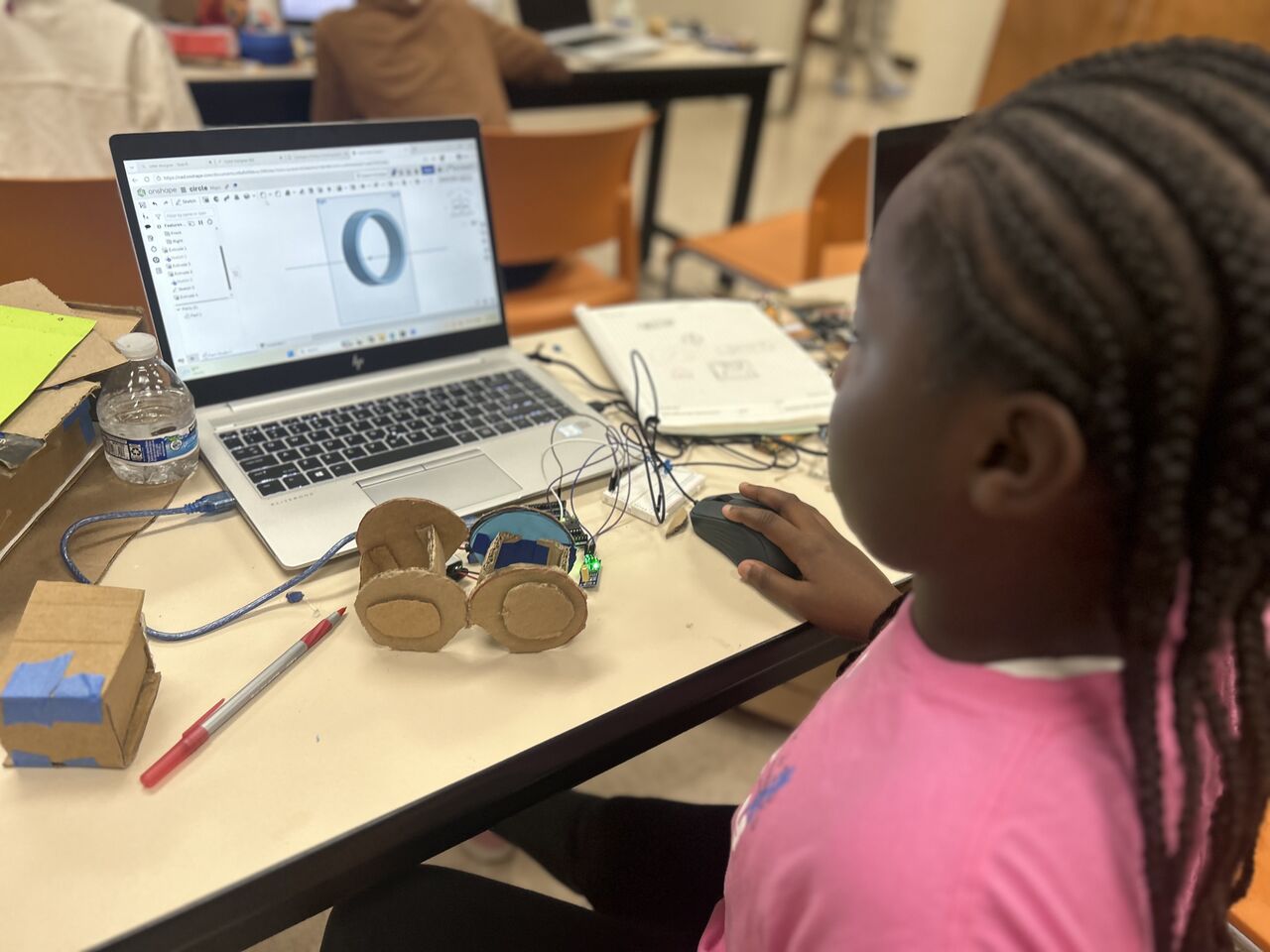
A student working on a mechatronics prototype with CAD and microcontrollers

Students Explore

  • Design Thinking and human-centered design
  • Problem identification and empathy research
  • Engineering design and prototyping
  • Mechatronics and physical computing
  • Electronics, sensors, and microcontrollers
  • Computer-Aided Design (CAD)
  • 3D printing and digital fabrication
  • Scrum and sprint-based project management
  • Lean Startup and Build–Measure–Learn
  • Business Model Canvas
  • Entrepreneurship and value creation
  • Engineering notebooks and technical documentation
  • Pitch development and presentation

The Experience

Students don't simply complete projects—they learn how to become innovation leaders capable of identifying meaningful problems, working collaboratively, managing complex projects, building prototypes, learning from failure, and transforming ideas into solutions.
Recommended Pathway: Foundational / Entry CoursePrimary Areas: Innovation • Engineering • Entrepreneurship • Mechatronics
Course 02

Biomechatronics

Engineering at the Intersection of Humans and Machines

Biomechatronics introduces students to the rapidly evolving field where biology, engineering, electronics, robotics, and computer science converge.

Students investigate how technology can interact with the human body to restore, enhance, or better understand human movement and function. Authentic healthcare and rehabilitation challenges provide the context for learning engineering and scientific concepts.

Students may explore technologies associated with prosthetics, assistive devices, rehabilitation engineering, electromyography (EMG), sensors, robotics, and human-machine interfaces.

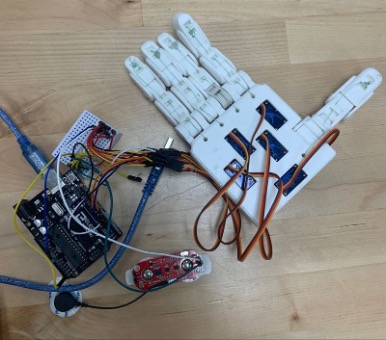
A student-built biomechatronic hand prototype with sensors and microcontrollers

Students Explore

  • Human anatomy and biomechanics
  • Biomedical and rehabilitation engineering
  • Sensors and data acquisition
  • Electromyography (EMG)
  • Microcontrollers and physical computing
  • Mechanical and electronic prototyping
  • Assistive technology
  • Prosthetics and rehabilitation devices
  • Human-machine interaction
  • Experimental design and research
  • Data collection and analysis
  • Artificial intelligence and machine learning applications

The Experience

Students work as emerging researchers and engineers, using the AE4 Innovation Learning Cycle to investigate problems affecting human health and mobility and develop prototype solutions.

Projects can become the foundation for advanced STEM+C Research experiences, university mentorships, research presentations, and multi-year Innovation Scholar pathways.

Recommended Pathway: Intermediate / AdvancedPrimary Areas: Bioengineering • Robotics • Healthcare • Research
Course 03

Computer-Aided Design

Imagine It. Model It. Make It.

Computer-Aided Design (CAD) teaches students to transform ideas into precise digital models that can be engineered, tested, manufactured, and improved.

Students develop three-dimensional design and engineering skills while applying CAD to authentic challenges. Rather than learning software commands in isolation, students use CAD as a tool within the innovation process.

From assistive devices and mechanical components to product prototypes and research equipment, students learn how professional designers and engineers communicate ideas through digital models.

Students using computer-aided design software to model precise engineering drawings

Students Explore

  • 2D sketches and technical drawings
  • Parametric 3D modeling
  • Engineering dimensions and constraints
  • Assemblies and mechanical relationships
  • Design for manufacturing
  • Design for 3D printing
  • Rapid prototyping
  • Iterative product development
  • Engineering documentation
  • Design optimization
  • CAD within the Design Thinking process

The Experience

Students progress from learning foundational CAD skills to designing components and systems that address authentic problems. CAD becomes more than a software skill—it becomes a language for innovation, allowing students to communicate, test, refine, and manufacture their ideas.

Recommended Pathway: Foundational / IntermediatePrimary Areas: Engineering Design • Digital Fabrication • Product Development
Course 04

Artificial Intelligence & Machine Learning

Teaching Machines to Help Solve Human Problems

AI & Machine Learning introduces students to the concepts behind intelligent systems while challenging them to consider how these technologies can be applied responsibly to real-world problems.

Students move beyond simply using generative AI tools. They investigate how data can be collected, prepared, analyzed, and used to develop machine-learning models and intelligent prototypes.

Projects may connect AI with healthcare, robotics, computer vision, physical computing, environmental research, entrepreneurship, and other areas of student interest.

Students Explore

  • Foundations of artificial intelligence
  • Machine learning concepts
  • Data collection and preparation
  • Training and testing models
  • Classification and prediction
  • Computer vision
  • Sensors and intelligent systems
  • AI-enabled physical computing
  • Generative AI
  • Model evaluation and iteration
  • Bias, ethics, privacy, and responsible AI
  • Human-centered AI design

The Experience

Students learn that effective AI begins with more than an algorithm—it begins with understanding the problem, the user, and the data.

Using the AE4 Innovation Learning Cycle, students identify meaningful applications for AI, build and evaluate solutions, and examine both the possibilities and responsibilities associated with intelligent technologies.

Recommended Pathway: Intermediate / AdvancedPrimary Areas: AI • Computer Science • Data • Innovation
Course 05

Virtual Reality for Physical Therapy & Rehabilitation

Building Immersive Technology for Human Recovery

VR for Physical Therapy & Rehabilitation challenges students to explore how immersive technologies can be used to support physical therapy, rehabilitation, mobility, and patient engagement.

Students investigate authentic rehabilitation challenges and work at the intersection of healthcare, game design, virtual reality, engineering, and human-centered design.

Rather than creating VR experiences solely for entertainment, students explore how immersive environments can become tools for therapy and rehabilitation.

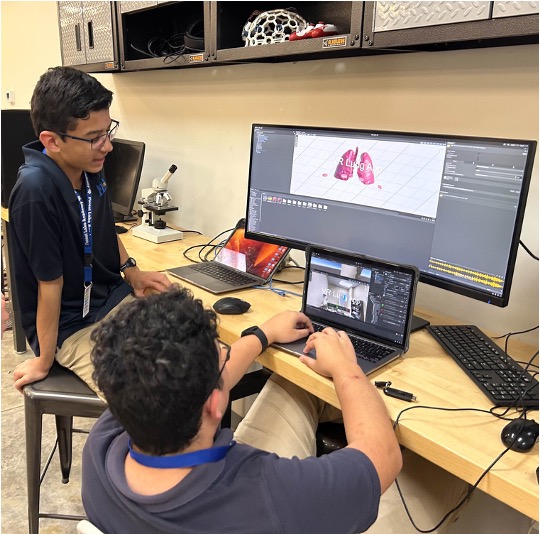
Students designing a virtual reality rehabilitation environment on a workstation with 3D models of human anatomy

Students Explore

  • Virtual and immersive environments
  • Fundamentals of physical therapy and rehabilitation
  • Human movement and biomechanics
  • Human-centered healthcare design
  • Game mechanics and patient engagement
  • Unity and interactive development
  • VR hardware and interfaces
  • Physical computing
  • Motion and interaction
  • User testing
  • Data collection and analysis
  • Prototype validation and iteration

The Experience

Students begin by understanding the needs of patients, therapists, and other stakeholders. They then design and develop immersive prototypes intended to address specific rehabilitation challenges.

Depending on the project, students may collaborate with healthcare professionals, researchers, engineers, or university partners to evaluate their concepts and improve their designs.

The result is a powerful interdisciplinary experience connecting computer science, healthcare, engineering, research, and empathy.

Recommended Pathway: Intermediate / AdvancedPrimary Areas: Virtual Reality • Physical Therapy • Healthcare Innovation • Research
Course 06

Brain-Computer Interfaces & Neuroscience

Exploring the Connection Between the Brain and Technology

Brain-Computer Interfaces (BCI) & Neuroscience introduces students to the emerging field where neuroscience, engineering, computer science, artificial intelligence, and human-machine interaction converge.

Students investigate how the brain and nervous system communicate, how neural and physiological signals can be measured, and how those signals can potentially be used to interact with computers, machines, assistive technologies, and other intelligent systems.

Rather than studying neuroscience only as a theoretical subject, students approach the brain from the perspective of an emerging researcher and innovator—asking how technology can help us better understand the brain and address authentic human problems.

Students Explore

  • Foundations of neuroscience
  • Brain anatomy and nervous system function
  • Neurons and neural communication
  • Electrical activity of the brain
  • Electroencephalography (EEG)
  • Biosensors and physiological signals
  • Signal acquisition and processing
  • Brain-Computer Interfaces (BCI)
  • Human-computer and human-machine interaction
  • Artificial intelligence and machine learning
  • Data collection, visualization, and analysis
  • Assistive and rehabilitation technologies
  • Experimental design and research methodology
  • Neurotechnology ethics, privacy, and responsible innovation

The Experience

Students explore how researchers and engineers translate biological signals into meaningful data. Through hands-on investigations, they learn to collect, visualize, analyze, and interpret physiological and neural signals while examining how these signals might be incorporated into interactive technologies.

Using the AE4 Innovation Learning Cycle, students can progress from investigating a neuroscience-related problem to designing experiments, collecting data, developing prototypes, and evaluating potential applications.

Projects may explore areas such as BCI-controlled devices, assistive technologies, rehabilitation, human performance, neural signal analysis, accessibility, and human-machine interaction.

As students advance, BCI & Neuroscience projects can incorporate AI and machine learning to investigate patterns within biological data and explore how intelligent systems can interpret human physiological signals.

From Classroom to Research

BCI & Neuroscience is designed to provide a bridge between K–12 STEM education and authentic university-level research.

Advanced students may develop projects suitable for continued investigation through the AE4 Innovation Scholar Program, university mentorship, research experiences, poster presentations, and interdisciplinary collaborations with researchers in neuroscience, engineering, healthcare, and computer science.

The course provides students with an early opportunity to experience what it means to think and work like a neuroscientist, engineer, and technology innovator.

Recommended Pathway: AdvancedPrimary Areas: Neuroscience • Brain-Computer Interfaces • Bioengineering • Artificial Intelligence • Research
Course 07

Saponification: The Chemistry of Soap Making

Where Chemistry Becomes a Product

Saponification: The Chemistry of Soap Making transforms chemistry from an abstract science into a hands-on exploration of chemical reactions, formulation, product design, and entrepreneurship.

Students investigate the science behind soap and personal-care products while learning how chemical principles are used to develop products that people use every day. The course uses soap making as a platform for applied chemistry, allowing students to connect scientific concepts with experimentation, manufacturing, innovation, and entrepreneurship.

Through the AE4 Innovation Learning Cycle, students move beyond following recipes. They investigate ingredients, formulate and test products, analyze results, modify formulations, and explore how chemistry can become the foundation for new products and entrepreneurial ventures.

Students Explore

  • Atoms, molecules, and chemical bonding
  • Acids, bases, and pH
  • Organic chemistry fundamentals
  • Fats, oils, and fatty acids
  • Triglycerides and molecular structure
  • The chemistry of saponification
  • Stoichiometry and chemical calculations
  • Chemical reactions and reaction variables
  • Properties of different oils and ingredients
  • Formulation and experimental design
  • Product testing and quality control
  • Laboratory safety and scientific documentation
  • Sustainable and environmentally responsible product development
  • Product design and packaging
  • Cost analysis and manufacturing considerations
  • Branding and entrepreneurship

The Experience

Students begin by investigating the chemistry behind a familiar product: soap. They examine how the molecular properties of different fats, oils, bases, and additives influence the characteristics of a finished product.

Students then apply chemistry through laboratory investigations and controlled formulation experiments. They learn to manipulate variables, document procedures, collect data, compare formulations, and use evidence to improve their products.

Instead of asking only, “How do you make soap?”, AE4 students are challenged to ask: Why does this chemical reaction work? How does changing the chemistry change the product? How can we design a better product for a particular user or need?

From Chemistry to Chemical Engineering

The course can also serve as an early introduction to concepts students may encounter in chemical engineering, materials science, cosmetic science, pharmaceutical science, and product development.

Students begin to see how chemists and engineers move from laboratory chemistry to scalable products by considering formulation, process control, consistency, quality, cost, safety, sustainability, and manufacturing.

From Laboratory to Entrepreneurship

Saponification also provides a natural connection between STEM and entrepreneurship.

Students can use their chemistry knowledge to develop an original product concept, identify a target customer, experiment with formulations, calculate production costs, design packaging, develop a brand, and construct a business model.

Chemistry → Experimentation → Formulation → Product Development → Validation → Entrepreneurship

Students learn that chemistry is not simply something studied in a laboratory—it can become the foundation for creating products, solving problems, launching ventures, and pursuing careers in science and engineering.

Recommended Pathway: Foundational / IntermediatePrimary Areas: Chemistry • Chemical Engineering • Product Development • Entrepreneurship

More Than Courses. Innovation Pathways.

AE4 courses are designed to connect.

A student might begin with Fundamentals of Innovation, Mechatronics & Entrepreneurship, discover an interest in healthcare, develop advanced skills through Computer-Aided Design, explore human movement through Biomechatronics, incorporate AI & Machine Learning, and ultimately develop an immersive rehabilitation solution through VR for Physical Therapy & Rehabilitation.

What begins as a course can become a multi-year personalized pathway.

ExploreLearnDesignBuildResearchInnovate

Along the way, students may have opportunities to work with mentors, researchers, universities, healthcare professionals, and industry partners while developing portfolios that demonstrate what they can actually do.

Where Will Your Innovation Journey Begin?

Whether a student is interested in engineering, healthcare, entrepreneurship, artificial intelligence, research, or emerging technology, AE4 provides a pathway for turning curiosity into capability—and capability into meaningful innovation.